The Cult of R.O.B. — Research Dossier
Prepared for the $ROB Collector Fund whitepaper — July 22, 2026
Thesis in one line: R.O.B. (Robotic Operating Buddy, NES, 1985) is the accessory that ended the great video game crash, canonized by Nintendo for four decades, sitting in the one collectibles segment — graded hardware — where price discovery has barely begun. A loose unit trades at ~$133. The sealed set built around it holds the all-time auction record for a commercially released console: $120,000.
1. The Trojan Horse (history & cultural significance)
The crash. After the 1983 North American video game crash, US home console revenue collapsed from a peak of roughly $3.2 billion (1982) to approximately $100 million by 1985 — a ~97% wipeout (widely cited estimates for the North American console market; roughly 80% of the peak was Atari's). Retailers, burned by fire sales of unsold Atari-era inventory, had lost confidence in the category entirely.
The gambit. Nintendo's answer was to reposition the Famicom as the "Nintendo Entertainment System" — an electronic toy anchored by a one-foot-tall robot. R.O.B. was originally created by Gunpei Yokoi (Game & Watch, the D-pad, later the Game Boy) as Japan's Family Computer Robot (model HVC-012, ¥9,800), released July 26, 1985. Nintendo of America then repurposed it as the retail wedge for the NES launch: marketing lead Gail Tilden has confirmed the strategy was deliberate — "we never used the word 'video game' at all." Nintendo paired the robot with consignment-style terms: retailers paid nothing upfront, received 90 days' credit, and could return unsold inventory.
The launch. The NES debuted in a New York City test market, officially dated October 18, 1985, with roughly 100,000 Deluxe Sets shipped — every one containing R.O.B., the Zapper, Gyromite, and Duck Hunt, at $179.99 retail. It was the only configuration offered. Nintendo claimed nearly 90,000 units sold in nine weeks; retrospective accounts put holiday sales at 50,000–90,000. Either way, the blockade was broken. A 1986 Nintendo-commissioned survey of NES owners found the number-one purchase motivator was that children wanted the robot. In July 2003, GameSpy ranked the R.O.B. strategy fifth among "The 25 Smartest Moments in Gaming."
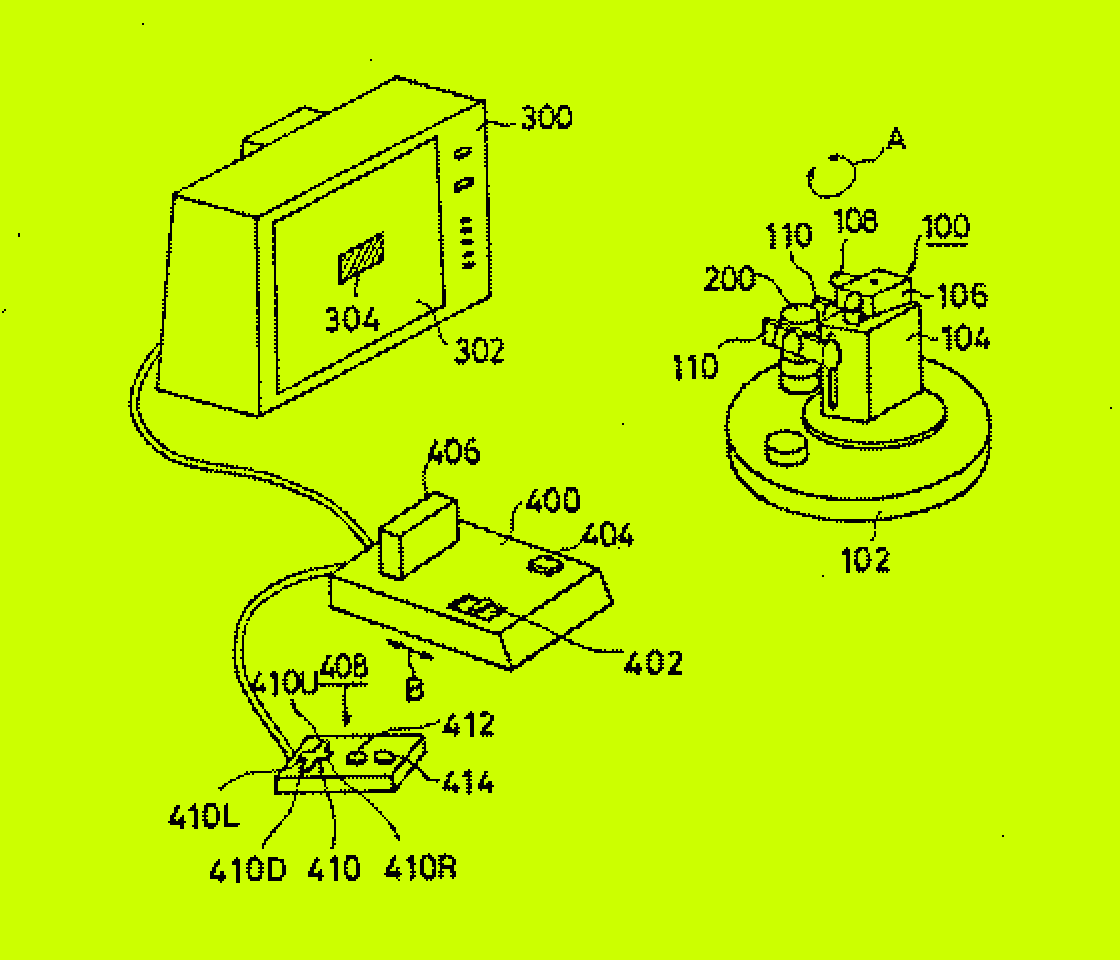
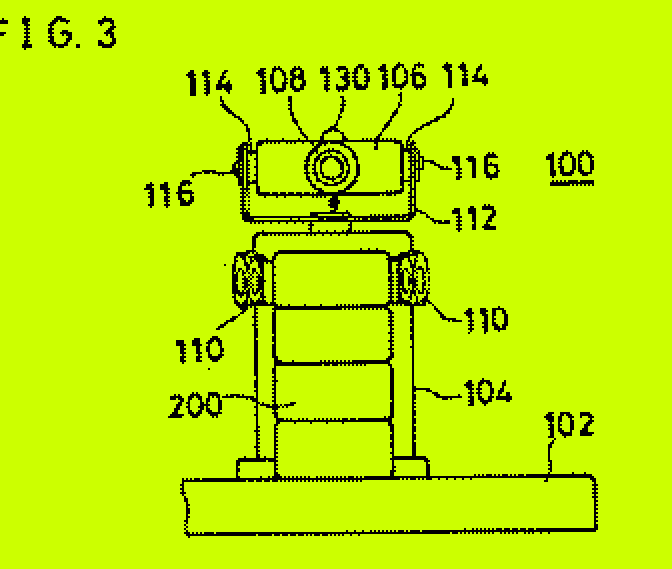
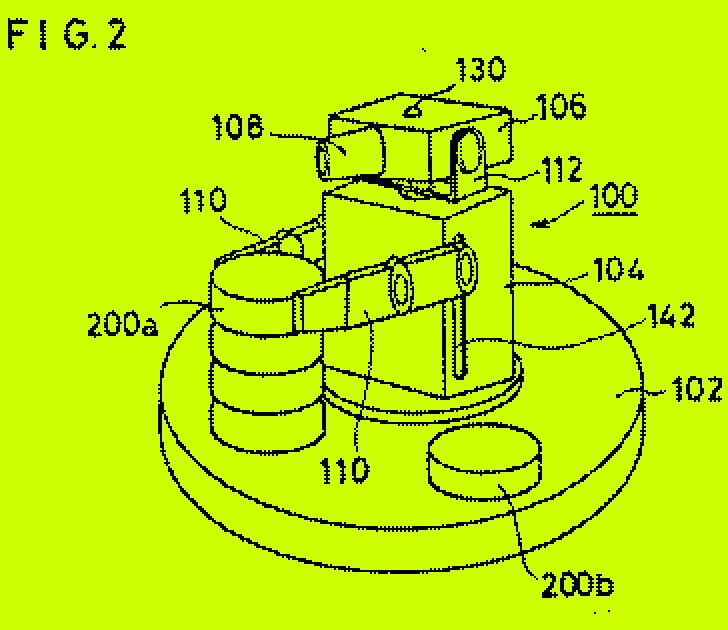
The paradox. As a toy, R.O.B. underwhelmed — its head reads timed light flashes from a CRT screen (the same photosensing approach as the NES Zapper; Yokoi's US Patent 4,815,733, issued March 28, 1989), decoding six commands into slow, imprecise movements. Historian Chris Kohler concluded that once the novelty wore off, R.O.B. "got in the way of enjoyment." Only two compatible games ever shipped — Gyromite and Stack-Up — and four more announced "Robot Series" titles were cancelled. But the NES it smuggled into stores sold 61.91 million units worldwide and revived the American games industry.
The canonization. Nintendo has kept R.O.B. alive continuously for 40 years: unlockable driver in Mario Kart DS (2005 — his kart "ROB-BLS" is literally named for HVC-BLS, Stack-Up's Japanese product code), playable fighter in Super Smash Bros. Brawl (2008, revealed as the Ancient Minister in Subspace Emissary) through Smash Ultimate, two amiibo colorways (NES gray; Famicom red/white, released March 18, 2016), a boss role in WarioWare: Smooth Moves, the ROB 64 homage in Star Fox, and — per Wikipedia's legacy section — a voiced appearance (Ed Skudder) in the 2026 Super Mario Galaxy Movie.
No other gaming accessory — not the Zapper, not the Power Glove — combines all four legitimacy axes: historical causality, a legendary designer, extreme scarcity of complete examples, and four decades of first-party canonization.
2. Scarcity Mechanics (production, survivorship, why complete units are rare)
Nobody knows how many exist — and that is the point. Nintendo never published a production or sales figure for R.O.B. The best documented proxy: Gyromite, bundled with every US Deluxe Set, sold 1,320,000 copies worldwide (CESA-sourced data, matching Japanese Wikipedia's figure for the Gyro Set). Since nearly all R.O.B. units reached consumers via that bundle, collectors infer worldwide distribution on the order of ~1–1.5 million units — explicitly an estimate. Japanese sources note the robot sold better in export markets than at home.
A short market life. R.O.B. was on the US market roughly 2.5–3 years as a bundle item: the Deluxe Set sold from October 1985 until 1988, when the R.O.B.-less Action Set replaced it (at retail by April 1988 per newspaper evidence; exact launch month disputed). R.O.B. also sold separately at $49.99 before being quietly discontinued. Hackaday's summary: the whole thing "tanked in two years." The oft-repeated claim that residual sales ceased by 1990 traces only to uncited fan wikis.
Four documented attrition drivers:
- Plastic chemistry. The US unit's gray ABS shell contains brominated flame retardants that destabilize under UV, yellowing badly; NES-era gray plastic lacks the protective carbon-black pigment of darker plastics. Retrobrighting is temporary and may accelerate long-term degradation.
- Battery corrosion. R.O.B. runs on 4 AA batteries (the Gyro Spinner takes a D cell); four decades of leaked alkaline cells have destroyed contacts. Repair threads also document a slipping spring-clip clutch on the gear hub as a common mechanical failure.
- The CRT problem. R.O.B. physically cannot be tested on modern displays — its optical command system requires an NTSC CRT's flash timing. Many surviving units trade "untested" because owners have no way to verify function.
- Lost parts. "Complete" is tiered: Gyromite-complete requires two gyros, Gyro Spinner, Gyro Holder, controller Gyro Tray, and gyro hands; Stack-Up-complete requires five colored blocks, five trays, and block hands. These are exactly the small parts children lost — enough that 3D-printed replacement-part projects exist on Thingiverse and GitHub. Stack-Up was never bundled with any console, making complete copies dramatically rarer than Gyromite. One Deluxe Set price guide notes missing game boxes alone can cut set value by over $1,000.
No census exists. Targeted searches found no published estimate of surviving working units — the only documented statement is Heritage Auctions' qualitative note that sealed Deluxe Sets are exceptionally rare because "nearly all examples opened or lost over time." With no production baseline and no census, survivorship is genuinely unquantified. For a thesis built on scarcity, that opacity is the opportunity: the population has never been counted, so it has never been priced.
3. The Grading Gap (population data — why graded supply is near zero)
Structural fact: the price-setting graders don't grade hardware. WATA (founded 2017–18, acquired by PSA's parent Collectors Universe in July 2021, fully rebranded as PSA by October 2025 — watagames.com's population report now literally redirects to psavideogames.com) and CGC Video Games (launched 2022) grade games only. Every graded R.O.B. console item in existence went through VGA — which publishes no public population report.
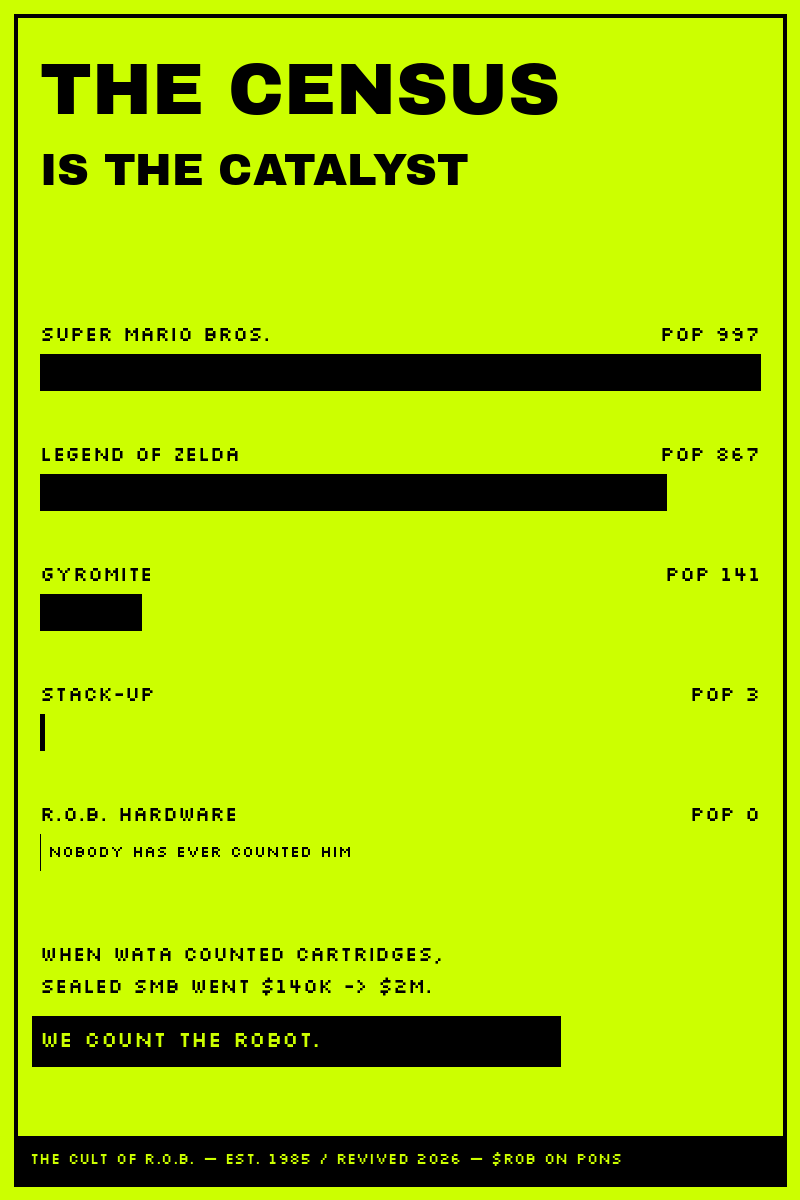
The population numbers, where they exist, are startling:
| Title |
Total PSA/WATA graded pop |
Sealed |
| Super Mario Bros. |
997 |
288 |
| The Legend of Zelda |
867 |
261 |
| Gyromite |
141 (1 loose / 121 CIB / 19 sealed) |
19 |
| Stack-Up |
3 (all loose) |
0 |
Stack-Up's zero-sealed figure was verified directly against PSA's official NES population report (May 2026 data): three loose cartridges of a single variant, zero CIB, zero sealed — ever. The mechanism: Stack-Up's oversized box (it contains R.O.B.'s physical blocks) never fit WATA's slabs; Heritage's own 2019 lot description confirms a sealed Stack-Up "cannot yet be contained within a Wata slab." The only sealed Stack-Ups in holders are VGA's — approximately 18 authenticated examples ever, per cllct reporting.
Auction record trail (thin by design):
- The record: never-opened 1986 NES Deluxe Set, VGA 85 NM+, $120,000 at Heritage, November 3, 2023 — the highest price ever paid at auction for a commercially released console, and the first sealed Deluxe Set Heritage had ever offered.
- The cliff below it: an opened VGA 80 NM Qualified Deluxe Set brought $15,000 at Heritage in November 2024 (lot 7382-28040 — only Heritage's second Deluxe Set ever). An opened 1985 test-market set, serial no. 0000353 — essentially among the first ~400 US-market units, missing only the Duck Hunt box — sold for a reported $2,400 in March 2020.
- Sealed Gyromite: peak of $43,200 (WATA 9.2 A+, matte sticker/US test market, October 29, 2021) among only ~65 Gyromite sales in Heritage's archive; $33,600 (WATA 9.4 A, May 2020); $27,600 (WATA 9.6 A++, April 2023); $8,250 for a WATA 6.0 A++ matte-sticker first-production copy in July 2020 — the first sealed sticker-variant black box title Heritage ever auctioned; post-boom, a PSA 9.4 A++ brought $8,125 in June 2026.
- Sealed Stack-Up: only 11 sales ever at Heritage. High: $13,750 (VGA 85+ matte sticker, May 2025); $10,200 (VGA ~80 matte sticker, January 2023); down to $1,080 for a VGA 60 Qualified.
And standalone R.O.B. hardware? Essentially no graded examples exist in the marketplace at all — current listings show only raw units at roughly $125–$760. Nobody grades R.O.B. That is the purest expression of the gap.
(Caveats: population figures aggregated via What The Slab carry medium confidence on exact digits; VGA publishes no official pop report; some Heritage prices are corroborated from press coverage rather than lot pages.)
4. Comparable Asset Analysis (what icons trade at; where R.O.B. sits)
NES software set the ceiling. A sealed WATA 9.8 A+ Super Mario Bros. sold for $2,000,000 in August 2021 via Rally — which had bought it in April 2020 for $140,000, a 14x in 16 months. Before that: $660,000 for a WATA 9.6 A+ SMB at Heritage (April 2, 2021), and $870,000 for a sealed early-production "NES R" Legend of Zelda (WATA 9.0/A, July 9, 2021 — fewer than five sealed copies of that production run are purported to exist), a record broken two days later by a WATA 9.8 A++ Super Mario 64 at $1,560,000.
The correction was real — and survived. Comparable Super Mario 64 copies fell from $1.56M (July 2021) to $800,000 (September 2021) to $240,000 for a VGA MINT 95 (October 2021), and a 2022 class action accused WATA of market manipulation. But by 2024–2026 the market normalized at a higher baseline: retro gaming valued around $3.8B in 2025 with ~10% projected annual growth, Heritage running an $8.4M video game signature auction, sealed items outperforming loose by 40–50% on eBay/Whatnot data, and CGC expanding flat-rate $40 grading to new platforms in January 2026.
Hardware lags software — that is the asymmetry. The all-time record for any commercially released console is the $120,000 sealed NES Deluxe Set — which contains R.O.B. — roughly 6% of the $2M software record on the same platform. Heritage's own publication described that sale as helping "firmly establish a separate, high-end market for console hardware." The Deluxe Set trajectory at Heritage is steep: ~$2,400 (2020, opened early-serial set) → $15,000 (2024, opened/Qualified) → $120,000 (sealed/graded). Hardware grading is structurally younger; graded populations are thin; price discovery is only beginning.
Adjacent comps say icons + rarity clear $50K+:
- Peripherals: the Xbox Steel Battalion controller ($200 MSRP, 2002, two compatible games — R.O.B.'s exact profile) now brings several hundred to $1,000+ CIB.
- Toy robots: a Masudaya Target Robot set a tin-robot record at $52,900 at Morphy Auctions; a Japanese "Machine Man" tin robot brought $86,100.
- Character toys: the rocket-firing Boba Fett prototype (~100 made) sold for $525,000 at Heritage in May 2024, then $1,340,000 at Goldin in August 2024 — a record for any toy, set well after the supposed boom.
- Academic support: an HSE Moscow study of 2,300+ LEGO sets (1987–2015), published in Research in International Business and Finance, found unopened toy sets returned at least 11% annually (8% real), beating gold, large stocks, and bonds, with individual sets up to +700%.
- NES scarcity pricing: sealed Stadium Events (
200 surviving copies in any condition) sold for **$42,000** — showing what quantified NES scarcity is worth even at far lower icon status than R.O.B.
Where does R.O.B. sit today? A standalone unit at ~$133 loose / ~$400 CIB. Against $50K–$120K+ realized for comparable robot toys and the R.O.B.-containing sealed sets, that is the gap.
5. Current Market State (2025–2026 prices, volume, trend)
All PriceCharting figures captured live July 22, 2026, and independently re-verified against the raw page data.
Standalone R.O.B. (NES):
| Tier |
Price |
Velocity |
| Loose |
$133.22 |
~3 sales/week |
| Complete-in-box |
$400.00 |
~1 sale/week |
| "New" (sealed) |
$1,600.00 |
~3 sales/year (data caveat below) |
| Graded |
$1,760.00 |
rare |
| Box only |
$134.93 |
— |
- Recent loose eBay solds (May–July 2026): $99–$300 band — $138 (Jul 2), $149.99 (Jul 5), $199.99 (Jun 17), $287.67 tested (Jun 25), $300 missing one claw (Jul 8). A live eBay sold-listings search returned 89 solds in ~90 days, plus an active parts economy (claws $45, gyro spinners $25–40, parts sets $89–150) supporting restoration.
- CIB standalone sales cluster at $250–$350; a CIB R.O.B. in its standalone retail box reached $649 on May 8, 2026.
- Trend: flat at the bottom, firming in the middle. Loose has oscillated in a $95–$140 band for 24 months ($137.49 in Jul 2024 → $95.00 in Jul 2025 → $133.22 now). CIB has been sideways in a $300–$430 band with a notable June–July 2026 uptick back to $400.
- Data-quality caveat we flag honestly: PriceCharting's $1,600 "New" price rests on a contaminated dataset — most tracked "New" sales are sealed eye-lens filter accessories at $45–$90. The last tracked sale of an actual sealed standalone robot was 2022. Treat the sealed standalone price as undiscovered, not $1,600.
NES Deluxe Set (the R.O.B. bundle): loose $724.09 (up from ~$490–600 in 2024–25 — genuinely appreciating), complete $777.24, with 2026 CIB solds clustering $700–810 (plus a $999.99 and a $1,999.99 outlier). High-condition examples outperform: $1,649.95 serviced CIB (May 2026), $2,999 factory-new circle-seal (March 2025), $5,100 "brand new" (September 2024).
Top tier: quiet since 2024. The record remains the November 2023 $120,000 sealed set; the most recent major result is the November 2024 $15,000 VGA 80 Qualified set. No headline R.O.B. results surfaced from 2025–2026 auctions — top-tier supply has simply not appeared.
Sentiment: steady, not frothy. Community attention in 2025–26 is nostalgia-driven ("R.O.B. saved Nintendo" YouTube retrospectives in early 2025; 8BitDo's October 2025 NES 40th-anniversary line with a R.O.B.-homage keychain; the 2026 Super Mario Galaxy Movie appearance — a possible demand catalyst with no measurable price spike yet). One capping factor collectors note: Japanese Famicom Robots import cheaply (~$30 loose via proxy, boxed sets under $150), which anchors the low end for players who just want a robot.
6. Precedent: Community-Owned Asset Funds (DAO structures that worked/failed)
What failed, and why:
- ConstitutionDAO (2021): raised ~$47M in ETH from 17,437 contributors in under a week, lost the Sotheby's auction to Ken Griffin's $43.2M bid — organizers could not bid higher because remaining funds were needed to insure, store, and transport the document, and the public raise telegraphed their ceiling. The unwind worked mechanically (Juicebox redemption at 100%, fixed 1,000,000 PEOPLE : 1 ETH, redeemable at any time) but gas fees savaged small holders (one contributor paid $70 to donate $200 and $70 more to refund it; median contribution ~$206–217; ~$23M still unrefunded six days after the loss). PEOPLE then kept trading as a pure memecoin despite having, per the project's own statement, "no rights, governance, or utility" beyond ETH redemption. Lessons: audited fixed-ratio redemption is the trust anchor; never telegraph your max bid; small-holder friction is a design problem.
- SpiceDAO (2022): overpaid ~$3M (roughly 100x typical price) for the Jodorowsky Dune bible after publicly telegraphing its treasury, discovered physical ownership conferred no IP rights, and dissolved — auctioning the book and making treasury ETH claimable against $SPICE.
- FriesDAO (2022): raised $5.4M for fast-food franchises and died of operational security — a Profanity vanity-address exploit drained $2.3M. Key management is existential.
What worked:
- LinksDAO: raised $10.5–11M via membership NFTs (January 2022) that grant advisory-capacity votes and perks but explicitly no equity — a deliberate securities firewall. It then bought Spey Bay Golf Course in Scotland (~$1M, closed May 2023, after a vote with 80.5% holder participation), acquired partial ownership of Hillcrest Country Club in 2025, and launched a $LINKS token on Base. The strongest precedent for a community fund operating real assets.
- PleasrDAO: bought Wu-Tang's "Once Upon a Time in Shaolin" for $4M from the US government (2021), holds ~$32M in treasury assets (Jan 2026) with professional staff — but its fractionalization experiment is the cautionary tale: the $4M Doge NFT split into ~17B DOG tokens briefly implied a $300M+ valuation, then fell 99.3% from its November 2021 peak. Fractional tokens on a single illiquid asset trade as sentiment, not NAV.
- FlamingoDAO: the compliant profit-sharing route — a Delaware LLC capped at ~100 accredited investors with true pro-rata distributions. Legal, but closed-access.
- Collector Crypt / Courtyard / Phygitals (2024–26): the current-generation template — insured third-party vaults, physical-backed NFTs, burn-to-redeem shipping (2% withdrawal fee), instant buybacks up to 92% of FMV. The sector did $124.5M in monthly volume in August 2025 (5.5x annual growth). Collector Crypt's CARDS token hit ~$700M FDV before falling to ~$124M — proof the model raises real money and that token price decouples violently from inventory value. At the institutional end, Hong Kong-listed MemeStrategy launched the first tokenized Pokémon card fund in January 2026, targeting 25% of the ~47,000-population PSA 10 "Pikachu with Grey Felt Hat" (valued at $940M+).
Regulatory backdrop: Wyoming/Utah/Tennessee DAO LLC wrappers provide liability shielding but do not exempt tokens from the Howey test; an unwrapped DAO with token control plus profit distribution risks default general-partnership treatment. Notably, in January 2025 White House crypto czar David Sacks stated memecoins and NFTs are collectibles, not securities — a softened posture, not a safe harbor.
Design implications for $ROB: audited escrow with fixed-ratio, always-on redemption (the ConstitutionDAO/Juicebox template); sealed bids only; insured third-party vaulting with on-chain pNFT representation and burn-to-redeem; token structured as a collectible/membership instrument with perks — not promised pro-rata profit distributions, which historically required the closed accredited-investor LLC route; and hardened key management with audited contracts.
7. The Asymmetry (the actual thesis, stated quantitatively)
The spread, in one table:
| Asset |
Price |
| Loose R.O.B. (the icon itself) |
$133 |
| CIB R.O.B. |
$400 |
| CIB R.O.B., standalone retail box |
$649 (May 2026) |
| Sealed Stack-Up, VGA 85+ |
$13,750 (May 2025) |
| Tin-robot auction record (Masudaya) |
$52,900 |
| Machine Man tin robot |
$86,100 |
| Sealed NES Deluxe Set containing R.O.B. |
$120,000 (all-time console record) |
| Sealed Super Mario Bros. — same platform, same year |
$2,000,000 |
The argument, stated plainly:
- The icon is real. R.O.B. is the marketing device that ended the 1983 crash's retail blockade — the #1 stated reason children wanted the NES in 1986, ranked the 5th smartest moment in gaming history, designed by Gunpei Yokoi, canonized by Nintendo continuously for 40 years including a 2026 theatrical film appearance. This is not manufactured lore; it is documented causality.
- The scarcity is real but uncounted. ~1–1.5M units estimated ever distributed (no official figure exists); four documented attrition mechanisms (UV-yellowing ABS, battery corrosion, CRT-dependence making units untestable, lost accessories); no survivorship census anywhere. Stack-Up's PSA population is 3; sealed examples number ~18, all via VGA.
- The price discovery has not happened. Graded standalone R.O.B. hardware supply is functionally zero — the dominant graders do not grade hardware at all, VGA publishes no pop report, and marketplace listings show only raw units. The last tracked sealed standalone robot sale was 2022. The hardware record ($120K) is 6% of the software record ($2M) on the same platform, and that hardware market was explicitly described as newly established in late 2023.
- The precedent multiple. When WATA census data quantified sealed-cartridge scarcity in 2019–2021, prices moved 10–100x (Rally's SMB: $140K → $2M in 16 months; Deluxe Sets: $2,400 → $15,000 → $120,000 across the condition curve). If graded-hardware population data does for R.O.B. hardware what census data did for sealed software, the gap between a $400 CIB robot and the $50K–$120K+ cleared by comparable robot toys and R.O.B.-containing sealed sets is the asymmetry. Even the boring base case has support: academic research on unopened toy sets (LEGO, 2,300+ sets, 1987–2015) found ≥11% annual returns, beating gold and equities.
- The entry is cheap and liquid. At ~$133 loose / 3 sales a week, a fund can accumulate meaningful position size at rounding-error prices relative to every comparable, with an active parts economy supporting restoration and a defined grading pathway (VGA today; the graded-hardware infrastructure the thesis anticipates tomorrow).
The fund's edge is doing what no individual collector has done: count, restore, grade, and vault a population that has never been counted — and let the census create the market.
8. Risks (honest: liquidity, authenticity, plastic degradation, regulatory)
Market and liquidity risks
- The base market is flat. Loose R.O.B. has oscillated in a $95–$140 band for two years with no appreciation. The thesis requires a regime change (graded-hardware price discovery), not momentum.
- Top-end illiquidity. "New" sales run ~3/year; the graded top end has been silent since November 2024. Exit at size is unproven.
- Correction precedent. 2021 showed comparable assets falling 50–85% on grade/label sensitivity (SM64: $1.56M → $240K in three months), amid a class action alleging grader-driven manipulation. PriceCharting's own $1,600 sealed figure is contaminated by accessory sales — headline prices in thin markets can be artifacts.
- Supply overhang. Standalone R.O.B. units are far more common than sealed Deluxe Sets (~1–1.5M distributed), and Japanese Famicom Robots import at ~$30 loose, anchoring the low end.
- Unquantified scarcity cuts both ways. No survivorship census exists. If a census reveals abundance rather than scarcity, the thesis inverts.
Asset risks
- Plastic degradation is chemical destiny. Brominated flame retardants in the gray ABS yellow under UV; retrobrighting is temporary and potentially damaging. Vaulted units require UV-controlled, climate-controlled storage — a permanent carrying cost.
- Verification requires a CRT. Units cannot be function-tested on modern displays; "working" claims are hard to underwrite, and mechanical failures (clutch slip, corroded contacts) are common.
- Authenticity/completeness. Thriving 3D-printed replacement-part projects mean "complete" sets may contain reproduction gyros, trays, claws, and blocks. No hardware grader publishes a population report; VGA is a single point of authentication failure.
- Grading-infrastructure dependence. The thesis partially depends on graded-hardware infrastructure that does not yet exist at WATA/PSA/CGC scale. It may never arrive.
Structural and regulatory risks
- Token-NAV decoupling is the norm, not the exception. DOG: −99.3% from peak. CARDS: −80%+ from peak FDV. A $ROB token should be expected to trade on sentiment in both directions regardless of vault contents.
- Securities exposure. A token carrying profit expectation from the fund's efforts invites Howey scrutiny; DAO LLC wrappers do not exempt tokens, and unwrapped structures risk general-partnership liability. The 2025 "memecoins are collectibles" posture (David Sacks) is a policy statement, not law, and can reverse. Compliant profit-sharing has historically required the closed accredited-investor route (FlamingoDAO).
- Operational security. FriesDAO lost $2.3M to a single key-management exploit. Treasury custody, contract audits, and bid confidentiality (SpiceDAO, ConstitutionDAO both lost value to telegraphed treasuries) are existential, not optional.
- Nintendo IP. Owning physical units confers no rights to the R.O.B. character or trademarks (the SpiceDAO lesson). All branding must stay clear of implying Nintendo affiliation.
Sources
History and cultural significance
Production and survivorship
Grading and auction results
Comparable assets
Current market data (captured live 2026-07-22)
DAO and fund-structure precedent
Methodology note: every claim above passed multi-source verification with adversarial refutation attempts, or is explicitly hedged as an estimate. Figures refuted in verification (e.g., a $249 launch price, a "missing Duck Hunt" auction detail) have been corrected or excluded. Market prices are point-in-time snapshots as of July 22, 2026, and fluctuate. Nothing in this dossier is investment advice; $ROB and the underlying collectibles are speculative assets that can lose most or all of their value.
Addendum — The Product Census (July 2026)
Independent SKU-level research, incorporated after the original dossier. This is the census the thesis said nobody had run: it turns out even counting the PRODUCTS took a dedicated effort.
The robot shipped in roughly 8 distinct retail SKUs, ever:
| # |
Region |
SKU |
Notes |
| 1 |
Japan |
Family Computer Robot (HVC-012) |
¥9,800, July 26 1985. Standalone only — never bundled with any game in Japan |
| 2 |
North America |
NES Deluxe Set — NYC test-market variant |
Blank "Deluxe Set" logo space, prototype game photos without Seal of Quality, N0-prefix serials, NES-CPU-01 boards |
| 3 |
North America |
NES Deluxe Set — nationwide (c. 1986–88) |
$249 retail; discontinued ~1988 when the Action Set took over |
| 4 |
North America |
Standalone R.O.B. box (NES-012) |
$49.99 retail. The "small box" — more sought-after than a robot pulled from a Deluxe Set |
| 5 |
PAL |
Deluxe Set — Mattel (PAL-A, NESE-001) |
UK/IE/IT/NZ/AU, from Sept 1986 |
| 6 |
PAL |
Deluxe Set — NOE/distributor variants (PAL-B) |
Bergsala (Scandinavia), GiG "Versione Italiana", post-1990 NOE |
| 7 |
PAL |
Standalone R.O.B. |
Documented via StrategyWiki |
| 8 |
Canada |
Bilingual Deluxe Set variant |
Documented in the collector market |
The two Robot Series games never contained the robot — not the separately boxed Gyromite/Stack-Up in the US, and not Robot Gyro/Robot Block in Japan (both sold separately from HVC-012). A conservative "product-type" count is 4; the ~8 reflects distributor variants collectors treat as distinct.
Corrections and sharpenings to the original dossier:
- Test-market retail price is disputed. $179.99 appears in several sources; Nerdly Pleasures says $249 even at test market; the nationwide set is consistently $249. And per Darren Rovell, the actual set that sold for $120,000 retailed for about $128 in December 1986 — making the sealed-survival multiple roughly 937x retail.
- First-holiday sales: Wired (via SVG) reports 50,000 sold of the 100,000 manufactured — half. Then "well over a million" Deluxe Sets across North America in 1986 (Zdziarski). US Gyromite parts are therefore common relative to Japan, where Robot BLOCK outsold Robot GYRO (it was cheaper) — so gyro parts are the scarce ones in Japan, the inverse of the US.
- The graded standalone R.O.B. does not exist. No professionally graded sealed standalone R.O.B. (NES-012) or Famicom Robot sale has ever been documented. The oft-cited "$15,999 sealed R.O.B." (Destructoid, 2011) was actually a VGA-graded Deluxe Set at a Buy-It-Now asking price with no bids — not a standalone, not a sale. A standalone CIB box sold for ~$1,540 (eBay Best Offer, September 2025); sealed standalone asks run $650–$1,500+.
- VGA's October census counts just three Qualified Deluxe Sets. The $15,000 Nov 2024 sale (Heritage #7382, lot 28040) was tied for highest-graded of those three. The $120,000 record is Heritage Signature #7350, lot 28114.
- Famicom Robot pricing conflict. PriceCharting lists loose at ~$216 on 4 sales/year; the raw import market runs ~$77 loose, with a boxed ungraded unit at $371 (eBay, August 2025). Treat the PriceCharting Famicom series as too thin to lean on — the earlier +1,022%/5Y stat is technically accurate to that series and practically unreliable.
- Stack-Up additional comps: Heritage results at $4,680 and $10,200 (matte sticker, Jan 2023) alongside the $13,750 VGA 85+ high.
What this changes for the fund: the standalone NES-012 box becomes the primary robot target (a sealed one is a genuine white whale — no graded example has ever surfaced, so the first VGA-graded sealed NES-012 defines its own market). Test-market Deluxe Sets get an authentication doctrine: blank logo space, matte stickers, N0 serial, NES-CPU-01 board — verify before paying premiums, since post-100k serials can appear in test-market boxes. Thresholds: a graded sealed standalone surfacing = new benchmark; sealed Deluxe prices materially below $120k = buyer's window.
Sources: Heritage Auctions lot records, Antiques & Auction News, Darren Rovell, RF Generation, Wired via SVG, Zdziarski hardware-authentication analysis, ConsoleVariations/Retro Gaming of Denver, StrategyWiki, VGA October census, eBay completed sales. Asking prices are never treated as sales.